


Revolt On The Tigris - The Sadr Uprising And Governing Iraq
Publisher: Hurst and Company
Format: Hardback
ISBN: 9781850657736
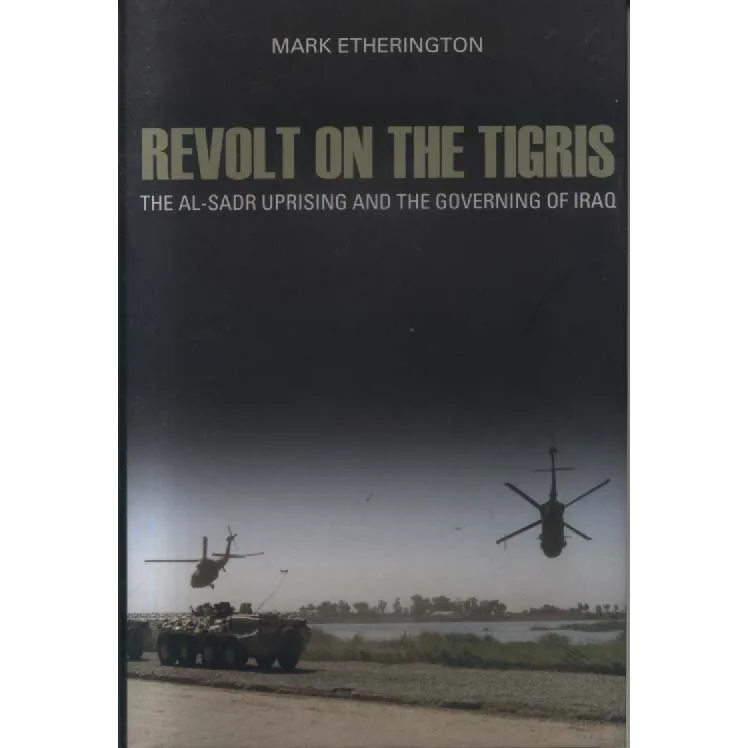
Revolt on the Tigris: The Sadr Uprising and Governing Iraq (2005) – Mark Etherington
Hurst & Company | ISBN: 9781850657736
Condition: Good | Sold by Crappy Old Books
Iraq, 2004. Saddam Hussein has been overthrown, the Americans have arrived, and the Coalition Provisional Authority is attempting to construct a functioning democratic state in a country where practically everybody has a different opinion about what that state should look like. Unfortunately, removing a dictator turns out to be considerably easier than persuading several million people to agree upon what ought to happen next.
Welcome to Revolt on the Tigris, Mark Etherington’s fascinating and frequently alarming account of the challenges confronting the occupation authorities during the turbulent aftermath of the 2003 invasion of Iraq.
Etherington was no distant commentator observing events from a comfortable London office. A former British Army officer, he served as the Coalition Provisional Authority’s governor in the Iraqi province of Wasit, placing him directly inside the extraordinary political, administrative and security problems that followed the collapse of Saddam’s regime.
His assignment was straightforward enough in principle: help establish effective government, restore public services, encourage political participation and provide the foundations for a stable Iraqi administration.
In practice, this meant attempting to govern a province amid collapsing institutions, competing political factions, widespread suspicion and an increasingly violent insurgency.
Not exactly the sort of circumstances in which one expects the local council’s annual budget meeting to proceed smoothly.
Central to the narrative is the uprising associated with Muqtada al-Sadr, the influential Shia cleric whose Mahdi Army challenged coalition authority in 2004. The confrontation exposed the fragile foundations of the occupation and the considerable difficulties of imposing political order upon a society emerging from decades of authoritarian rule, sanctions and war.
Etherington describes the realities of governing amid this upheaval, where political decisions carried immediate consequences and the distance between official policy and conditions on the ground could be enormous.
There is a particularly bitter irony running through the entire enterprise. The coalition arrived promising liberation, democracy and reconstruction, yet found itself struggling to maintain security, establish legitimacy and persuade ordinary Iraqis that foreign administrators possessed a convincing understanding of their country’s needs.
Meanwhile, local rivalries, religious loyalties and political ambitions refused to arrange themselves into the convenient categories preferred by international planners.
The book offers an unusually direct perspective on occupation government, combining personal experience with observations about the wider failures, contradictions and challenges of the Iraqi reconstruction effort.
Rather than treating war as a sequence of battles and military operations, Etherington reveals the complicated business of attempting to administer a society in which the political settlement remains profoundly contested.
Published in 2005, while the consequences of the invasion were still unfolding, the book provides a valuable contemporary perspective on a decisive period in modern Middle Eastern history.
This 2005 Hurst & Company edition, offered in Good condition by Crappy Old Books, is an excellent acquisition for readers interested in the Iraq War, Middle Eastern politics, military history, international relations and the practical difficulties of post-conflict reconstruction.
A compelling account of political ambition confronting uncomfortable reality, illustrating how quickly confident plans for national transformation can dissolve when confronted by history, identity, violence and competing visions of the future.
Because overthrowing a government may require an army.
But building a functioning replacement requires something considerably more complicated.
And, as Iraq demonstrated, possessing an impressive collection of tanks is not necessarily a qualification for running a provincial council.
Keep browsing: See more War books Other books by Mark Etherington
